
What it looks like
The statements your colleagues fill in, and two finished reports. The people and the numbers are invented, the form is exactly what you get.
Why
You are buying a mirror without knowing its shape
That is the uncomfortable part of a 360. You ask five or more colleagues to be honest about how you communicate, and at that moment you do not yet know what you will get back. Which is why it is all here.
A classic 360 measures competencies and returns a list of scores. This one looks at something else: how you listen, how you put a difficult matter on the table, and what happens to others when you do. The numbers are the starting point. The coach's written reading is what it is about.
What it is not
-
Not an appraisal
No score goes into a personnel file and no decision hangs on it.
-
Not for your employer
Your organisation sees that your assessment is complete. Never what is in it.
-
No names
You read every answer, including the sharp ones. You do not read who gave which answer.
The questionnaire
Twelve statements, three open questions, ten minutes
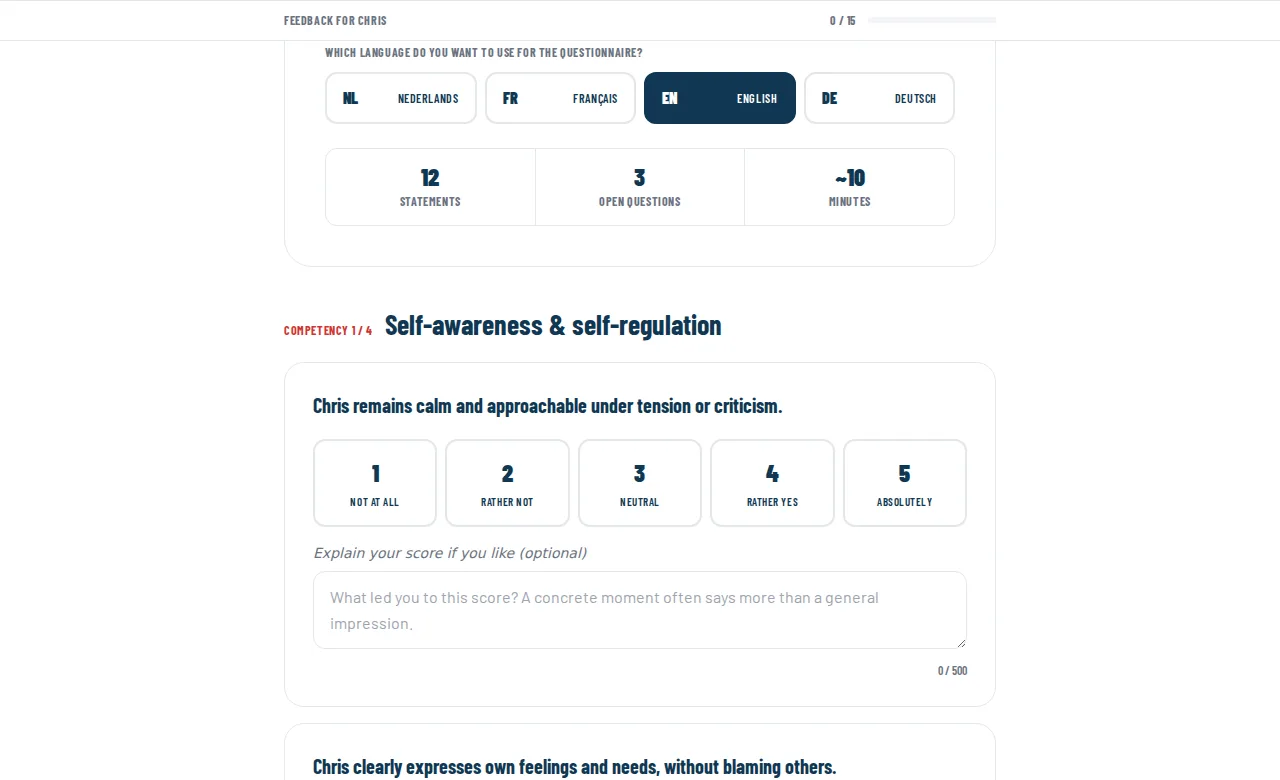
Below are four of the twelve statements, one from each competency, in the form your respondents receive them. With each statement they can briefly explain why. That comment field often yields more than the score.
Chris remains calm and approachable under tension or criticism.
Comment, optional
With me Chris puts everything on the table, including what is not pleasant to hear.
Chris checks whether they have correctly understood the other person.
Chris expresses observations without judgment or interpretation.
Chris contributes to shared decision-making, rather than dominating or withdrawing.
One of the three open questions
Where do you see growth potential for Chris in connecting communication?
A rendering of the form, not the form itself. You see the other eight statements once you begin.
The environment
Where it all happens
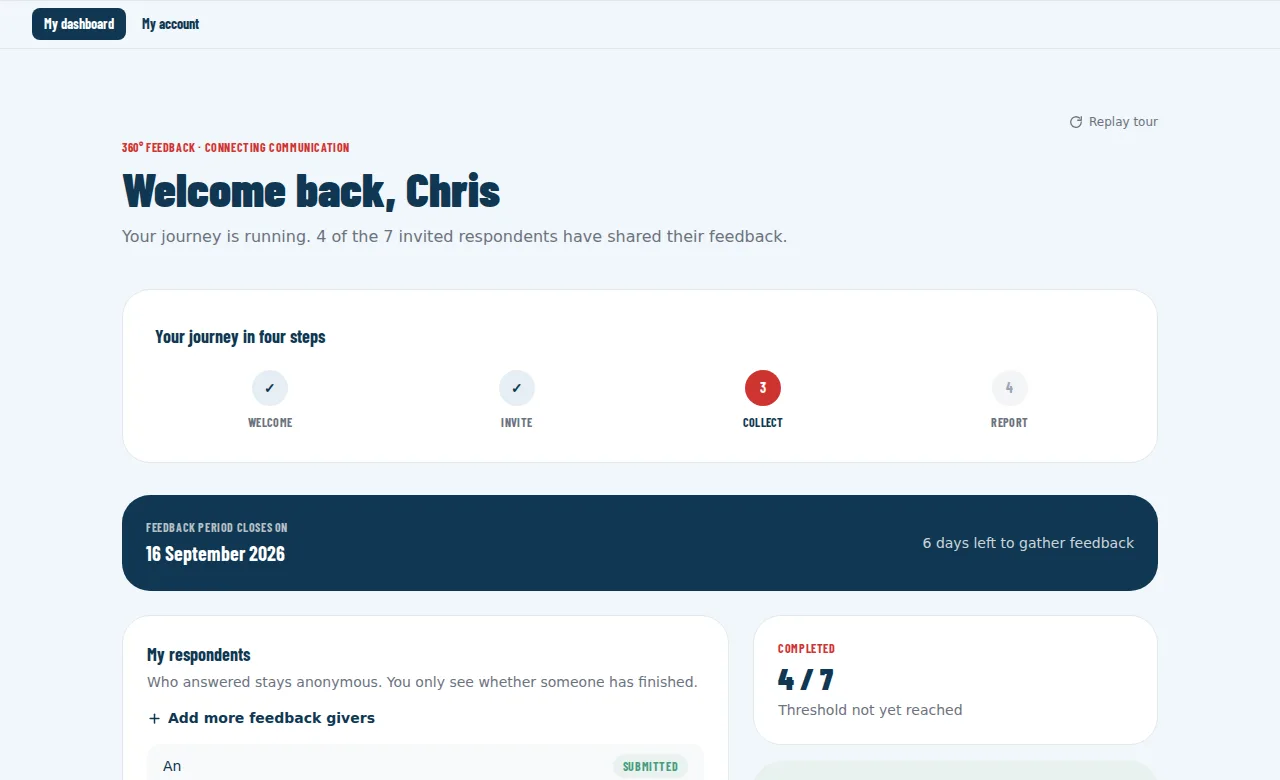
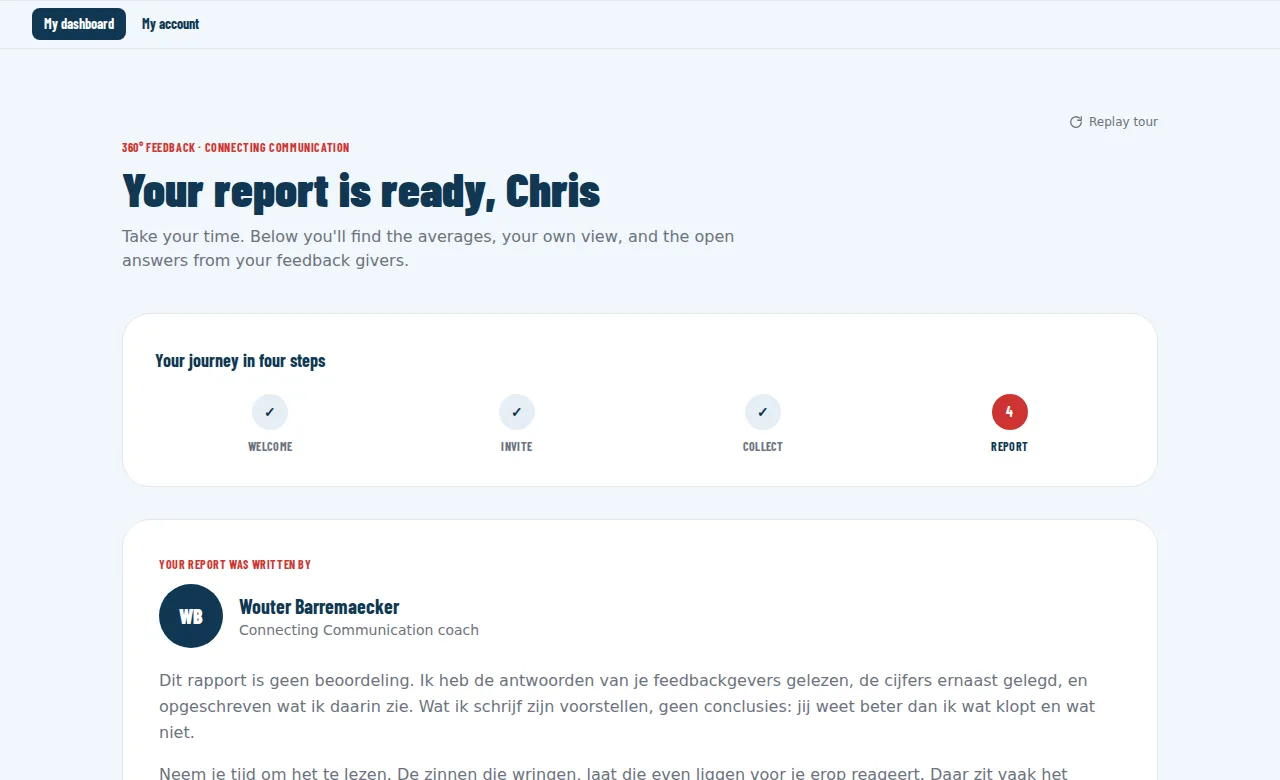
Three screens from the tool itself, with Chris's data in them. Not mockups: these are screenshots of the real environment.
The report
Two people, two very different outcomes
Chris rates himself or herself lower than the people around on every statement, and has one statement where the respondents thoroughly disagree. Kim rates higher everywhere, and at the same time gets the highest score of the two for daring to name difficult things. Not a good and a bad pupil, then, but two patterns that each show something different.
To keep the page readable we show three of the twelve statements. The coach's reading is there in full, because that is the part you cannot picture.
Example
Chris does not exist, neither does Zorggroep Ter Beuke, and the numbers and answers are invented. The report is written the way we would write it for a real participant, in the variant without coaching. In a real report, a button under the reading lets you book a conversation with your coach directly.
Your report was written by
Wouter Barremaecker
Connecting Communication coach
This report is not an assessment. I have read your respondents' answers, laid the numbers alongside them, and written down what I see there. What I write are suggestions, not conclusions: you know better than I do what fits and what does not.
Take your time reading it. The sentences that chafe, let them sit before you respond to them. That is often where the most is waiting.
01 · Overview
Four perspectives at a glance
The grey-blue shape shows how your surroundings rate you on average. The red shape shows how you rate yourself. Both on a 1-5 scale.
What others see
Average of 7 respondents
How you see yourself
Your self-evaluation
02 · Detail
By competency, in 3 questions
The bar shows the average of others, the red mark shows where you positioned yourself.
Self-awareness & self-regulation
You 3.0 · Others 4.2 / 5
Chris clearly expresses own feelings and needs, without blaming others.
Empathic listening
You 3.7 · Others 4.4 / 5
Chris shows genuine interest in underlying concerns or needs.
Clear & connecting expression
You 2.7 · Others 3.5 / 5
Chris addresses difficult issues in a respectful way.
03 · Open answers
In their own words
Three open questions, answered by all 7 respondents. Randomly sorted, without identification.
What do you appreciate most about Chris’s communication style?
7 answersRespondent A
Chris luistert echt. Niet dat knikken terwijl je al aan het antwoord bezig bent, maar echt luisteren.
Respondent B
Er valt niemand uit de boot. Chris merkt het als iemand stiller wordt.
Respondent C
Het geduld. Chris laat mensen uitpraten, ook als het lang duurt.
Respondent D
Rustig en betrouwbaar. Wat afgesproken is, gebeurt.
Respondent E
Chris onthoudt wat je verteld hebt en komt er later op terug. Dat doet niemand hier.
Respondent F
De rust. En dat er geen spelletjes gespeeld worden.
Respondent G
Chris vraagt door tot het klopt, in plaats van te veronderstellen dat het duidelijk is.
Where do you see growth potential for Chris in connecting communication?
7 answersRespondent A
Ik zou willen dat Chris vaker zegt wat hij of zij er zelf van vindt. Nu moet je er soms naar vissen.
Respondent B
Soms duurt het lang voor iets uitgesproken wordt. Tegen dan is het al drie keer rondgegaan.
Respondent C
Chris neemt te veel op zich. Vragen om hulp mag ook.
Respondent D
Ik zou graag horen wat beter kan aan wat ik doe. Nu hoor ik alleen als het goed is, en dan weet je het nog niet.
Respondent E
Duidelijker zijn in wat er verwacht wordt. Nu is het soms raden.
Respondent F
Af en toe wat meer positie innemen. Chris denkt eerst aan iedereen en dan pas aan het eigen standpunt.
Respondent G
Knopen doorhakken. Soms blijft iets te lang open omdat iedereen het eens moet zijn.
In which situations does Chris perform at their best?
7 answersRespondent A
Als het spannend wordt op de afdeling. Dan wordt Chris rustiger in plaats van gejaagder.
Respondent B
Bij nieuwe mensen. Die voelen zich meteen op hun gemak.
Respondent C
In gesprekken waar het emotioneel wordt.
Respondent D
Als er iets misloopt en er moet snel iets geregeld worden.
Respondent E
In het overleg met de families. Daar is Chris op zijn of haar best.
Respondent F
Wanneer twee partijen elkaar niet meer horen.
Respondent G
In moeilijke gesprekken met bewoners en hun familie.
04 · Coach interpretation
What this report tells me
My reading of the whole, from Connecting Communication.
Written feedback on your 360 Connecting Communication
A. What the data shows
Chris, you rated yourself cautiously in this 360. Of the nine people you invited, seven filled in the questionnaire. Their averages range from 3.3 to 4.7. On none of the twelve statements does your own score rise above the average of the people around you.
The gap between your self-image and how others see you is largest on:
- 1.2 (clearly expressing your own feelings and needs): self-score 2 against an average of 3.9
- 1.1 (staying calm and approachable under tension): self-score 3 against 4.4
- 3.3 (addressing difficult issues): self-score 2 against 3.3
On these statements the two views sit close together:
- 4.2 (seeking solutions that take different interests into account): 4 against 4.1
- 1.3 (taking responsibility for your own impact): 4 against 4.3
On 3.3 that average of 3.3 says very little. The seven answers run from 1 to 5 and fall into two groups: three people at the bottom, four at the top. It is the only statement in this report where your respondents clearly disagree with one another.
The lowest score in your whole report sits on 3.2 (making clear and feasible requests, rather than implicit expectations): 3.3 on average, and you rate yourself at roughly the same level with a 3. On that point, you and the people around you agree.
In the open answers your respondents value your calm and your patience above all. Several write that you genuinely listen instead of waiting for your turn, that you remember what someone told you and come back to it later, and that nobody gets left behind with you. The growth they name comes down to two things: they do not always know where you stand yourself, and some things sit unspoken for too long. Two people explicitly ask to hear what could be better about their own work. You write yourself that others mainly value your calm, and you name as your own growth point that you would rather let a conflict settle, sometimes for too long, and that you do not always say what you think when you expect it will not land well.
B. The reading
The first thing that stands out is the direction of the gap. On every single statement the people around you see more than you see in yourself, and the gap is largest precisely where you name your weak spot. You give yourself a 2 on clearly expressing your feelings and needs, where your respondents arrive at an average of 3.9. That does not mean they are right and you are wrong. It does mean that the severity with which you look at yourself is not shared by the people you work with.
Put the three largest gaps side by side and they have something in common. All three are about what you put out: what you feel and need, how you come across when things get tight, and whether you put a difficult matter on the table. The statements about what you take in look entirely different. Listening without interrupting sits at 4.6, genuine interest in what lies underneath at 4.7. The picture that emerges is of someone who takes in a great deal and gives back little, and who mainly experiences that as a shortcoming.
Then there is the divided statement, and it may be the most interesting finding in this report. On addressing difficult issues the answers run from 1 to 5. That is not noise. In the comments one person writes that you put everything on the table, including what is not pleasant to hear, adding that this is probably not how it goes with everyone. Someone else writes that what you think of their work has never come up. So there are two experiences of the same person, and the dividing line does not run through your skill but through the relationship.
Your own sentence, the one where you say you keep quiet when you expect it will not land well, fits that exactly. A careful hypothesis, in the language of Connecting Communication: there seems to be a strong need not to burden the other person, to keep the team steady, and to make room for what others need. That need serves you in many situations, and the people around you name it in so many words as a quality. In other situations that same need overtakes another one, namely people's need to know where they stand. And possibly your own need to take a position of your own, rather than always standing in between.
C. Two areas to work with
Below are two areas that come out of the data. With each one you will find questions that can help you look further, and a suggestion for opening a conversation with someone around you. None of this is prescribed. It is material, to use as it fits.
Area 1: with whom do you say it, and with whom do you not
The starting point is the statement your respondents disagree about. With some people you evidently put everything on the table, with others it stays unspoken. For the people in that second group the silence is not neutral: two of them write that they do not know what you think of their work, and that they miss it. The question underneath this area is not whether you can say difficult things, because you demonstrably can. The question is what makes you do it with one person and not with another.
Questions to sit with:
- When you think of the people you do say it to, what is different about those conversations? What happens in you, just before you begin?
- What feeling comes up when you consider saying something and swallow it anyway? And which need is asking for attention at that moment: keeping things calm, sparing the other person, protecting yourself, or something else?
- Can you recall a recent situation where you did not say something? What did you do instead, and what would you rather have done differently afterwards?
A suggestion: ask one or two people who filled in the questionnaire what they concretely notice when you let something difficult pass. Do they notice it? If so, how? The question "what would you like to hear from me that you are not hearing now" usually yields more than "what am I doing wrong".
Area 2: from caring for to asking for
This area comes from the lowest score in your report, 3.2 on clear and feasible requests, and from the 2 you gave yourself on naming your own needs. It is also the only point where you and the people around you fully agree, and that is what makes it usable. In the open answers it comes up twice in other words: that it is sometimes guesswork what is expected of you, and that you take too much on your own shoulders. A request is not an expectation. The first one the other person can hear; the second one they can only guess at.
Questions to sit with:
- How do you notice in yourself that you would rather solve something alone than ask for it? What goes through you in that second?
- What makes asking difficult: the thought that you cannot manage, that you are burdening someone, or that the answer might be no?
- Think of a task from last month that you took on while someone else could have done it. What would you have had to say to let it go?
A suggestion: try this week to make one full request, in the form of what you observe, what you need, and what you are concretely asking for, with someone where that feels low-risk. Then look not at the answer, but at what asking did to you.
D. A word as you read
This report is a snapshot, fed by seven people who took the trouble to fill in the questionnaire. Their answers are an invitation to reflect, not a verdict. It can help, after reading, to thank those seven people for their contribution, and to open a conversation with one or two of them about what you are taking from this.
Change in how you communicate grows mostly through small, repeated moments of awareness. One thing you do a few times this week weighs more than a grand resolution that evaporates after ten days. Should you notice that this material asks for a conversation with someone who looks along with you, guided coaching is one way to have it.
Wouter Barremaecker
Connecting Communication coach
This report stays available on your dashboard for 2 years. Zorggroep Ter Beuke sees that your assessment is complete, but never the content of this report. It's a snapshot, deliberately not offered as download or print: it lives between you and your coach.
Example
Kim does not exist, neither does Verhoeven Techniek, and the numbers and answers are invented. The report is written the way we would write it for a real participant, in the variant with two coaching sessions. In a real report, a button under the reading lets you book a conversation with your coach directly.
Your report was written by
Wouter Barremaecker
Connecting Communication coach
This report is not an assessment. I have read your respondents' answers, laid the numbers alongside them, and written down what I see there. What I write are suggestions, not conclusions: you know better than I do what fits and what does not.
Take your time reading it. The sentences that chafe, let them sit before you respond to them. That is often where the most is waiting.
01 · Overview
Four perspectives at a glance
The grey-blue shape shows how your surroundings rate you on average. The red shape shows how you rate yourself. Both on a 1-5 scale.
What others see
Average of 6 respondents
How you see yourself
Your self-evaluation
02 · Detail
By competency, in 3 questions
The bar shows the average of others, the red mark shows where you positioned yourself.
Self-awareness & self-regulation
You 4.0 · Others 3.4 / 5
Kim remains calm and approachable under tension or criticism.
Clear & connecting expression
You 5.0 · Others 4.0 / 5
Kim addresses difficult issues in a respectful way.
Handling tension & decision-making
You 4.3 · Others 3.1 / 5
Kim contributes to shared decision-making, rather than dominating or withdrawing.
03 · Open answers
In their own words
Three open questions, answered by all 6 respondents. Randomly sorted, without identification.
What do you appreciate most about Kim’s communication style?
6 answersRespondent A
Je weet waar je aan toe bent. Kim zegt het gewoon, ook als het niet leuk is.
Respondent B
Kim dekt het team af naar boven. Dat wordt hier te weinig gedaan.
Respondent C
Recht door zee, geen politiek. Bij Kim moet je niet raden wat er achter een zin zit.
Respondent D
Kim blijft kalm als het misloopt. Ik heb dat een paar keer gezien en het scheelt.
Respondent E
De vakkennis. Kim weet waar hij of zij over praat en dat geeft vertrouwen.
Respondent F
Duidelijkheid. Ik weet altijd wat er van mij verwacht wordt.
Where do you see growth potential for Kim in connecting communication?
6 answersRespondent A
Even wachten tot iemand uitgepraat is. En vragen wat wij ervan denken voor het beslist is, niet erna.
Respondent B
De beslissing valt vaak voor het overleg begint. Dan zit je daar voor de vorm.
Respondent C
Wat meer ruimte laten. Niet elk gesprek moet in vijf minuten rond zijn.
Respondent D
Draagvlak. Een beslissing die technisch juist is maar die niemand gedragen voelt, kost achteraf meer tijd dan ze uitspaart.
Respondent E
Vragen stellen in plaats van antwoorden geven. Ik denk dat Kim zou schrikken van wat er dan naar boven komt.
Respondent F
Ik heb niet het gevoel dat het Kim echt interesseert hoe het met mij gaat. Het gaat over het werk en dan is het gedaan.
In which situations does Kim perform at their best?
6 answersRespondent A
Bij een escalatie met een klant. Dan is Kim op zijn of haar best.
Respondent B
Als er een deadline is en niemand nog knopen durft door te hakken.
Respondent C
In overleg met andere afdelingen. Kim krijgt dingen los die anderen niet los krijgen.
Respondent D
Onder druk. Hoe hoger de druk, hoe helderder Kim wordt.
Respondent E
Als er technisch iets moeilijks opgelost moet worden.
Respondent F
Bij problemen met klanten.
04 · Coach interpretation
What this report tells me
My reading of the whole, from Connecting Communication.
Written feedback on your 360 Connecting Communication
A. What the data shows
Kim, you rated yourself highly in this 360, and highest of all on speaking clearly and on decision-making. Of the eight people you invited, six filled in the questionnaire. Their averages range from 2.5 to 4.5. On none of the twelve statements does the view of the people around you rise above your own rating.
The gap between your self-image and how others see you is largest on:
- 4.3 (contributing to shared decision-making, rather than dominating or withdrawing): self-score 5 against an average of 2.7
- 3.1 (expressing observations without judgment or interpretation): self-score 5 against 3.2
- 2.1 (listening without interrupting or immediately offering solutions): self-score 4 against 2.5
On these statements the two views sit close together:
- 1.3 (taking responsibility for your own impact): 4 against 3.8
- 3.3 (addressing difficult issues in a respectful way): 5 against 4.5
That 4.5 on 3.3 is in fact the highest score in your whole report. Your respondents genuinely do see you as someone who says what needs saying.
On 1.1 (staying calm and approachable under tension or criticism) the answers run from 2 to 5: four people at the bottom, two at the top. It is the only statement where your respondents clearly disagree with one another.
In the open answers they value your clarity and your expertise above all. Several write that with you they know where they stand, that no games are played, and that you cover the team upwards. One person explicitly mentions that you stay calm when things go wrong. The growth they name is strikingly unanimous: the decision often falls before the meeting has started, they are rarely asked what they think, and there is more need for questions than for answers. You write yourself that people value your clarity, and you name as your own growth point that you lack patience and sometimes move too fast.
There is a tension there worth holding on to: your word is patience, theirs is being part of the thinking. Those are not the same thing.
B. The reading
The pattern in this data is strikingly consistent. On every statement you rate yourself higher than the people around you do, and the gap is largest on decision-making. At the same time, the picture your respondents paint is anything but negative. They value that you are clear, that you genuinely do name difficult things, and that you cover them when it gets awkward higher up. The highest score in your report, a 4.5 on addressing difficult issues, says something you should not wave away: people see you as someone with nerve.
Put the three largest gaps side by side and all three are about the same space, the one between the moment you see something and the moment the others are there with you. Listening without interrupting sits at 2.5, checking whether the other person has been understood correctly at 2.7, and contributing to shared decision-making at 2.7. One person writes in a comment that they have not finished their sentence before the answer arrives. Someone else writes that in meetings they hear what has been decided, and that thinking along rarely happens. So your clarity is not the problem. What people are missing sits in the phase before it.
The most interesting tension sits between your own growth word and theirs. You write that you lack patience and sometimes move too fast, which is a matter of pace. They write about ownership, about thinking along, about being asked, which is a matter of who the decision belongs to. That difference matters, because deciding more slowly does not solve the second one. You can take a decision slowly and still take it alone. What the open answers are asking for is not that it takes longer, but that someone is there before it is settled.
Then there is the divided statement. On staying calm and approachable under tension the answers run from 2 to 5. When a group cannot agree about your calm, it usually means you do not hold that calm equally everywhere, and that the difference lies in who you are dealing with or in what is at stake. That is material for a conversation, not a verdict.
A careful hypothesis, in the language of Connecting Communication: there seems to be a strong need for clarity and for progress, and for the sense that things move forward when you take them in hand. That need demonstrably serves the team, and they say so themselves. Under pressure, that same need can overtake other people's need to weigh in on what gets decided. There may also be a need of your own underneath it, a need for trust: that things will be fine without you having to hold all of it yourself.
C. Two topics for the coaching sessions
Session 1: between pace and ownership
This topic touches the largest gap in your report, the 5 you gave yourself on shared decision-making against the 2.7 from the people around you, and what the open answers say about it. The central question to explore in the session: what happens in you at the moment when you can already see the solution and the group is not there yet? In the language of Connecting Communication this touches the move from strategy to need. Deciding now is a strategy, and it probably serves a deeper need for clarity or for progress. The session's question is which other strategy could serve that same need, without running over other people's need to weigh in. The distinction between your word, patience, and theirs, being part of the thinking, belongs here too. Something concrete to bring along: a decision from the past few months that you realised afterwards was not carried, and what you saw happening at the time.
Session 2: between being clear and hearing what has not been said yet
This topic comes from 2.1 and 2.2, the two lowest statements in your report, and from the disagreement on 1.1. It is about the phase before you speak. The central question to explore: how do you notice that someone had not finished what they were saying, and what makes you begin anyway at that moment? In the language of Connecting Communication this touches the difference between observation and interpretation: hearing someone's first sentence and thinking you know where it is going is an interpretation, even when it is right eight times out of ten. And it touches the disagreement about your calm: with whom do you manage to stay present, and what is different there? A concrete example helps here as well: a conversation from the past few weeks in which you knew halfway through what the other person was going to say.
Which topic comes first is something you decide together with your coach. They hang together, and the conversation about one will probably already shed light on the other.
D. A word as you read
This report is a snapshot, fed by six people who took the trouble to fill in the questionnaire. Their answers are an invitation to reflect, not a verdict. It can help, after reading, to thank those six people for their contribution.
The numbers in this report sit lower in several places than you expected. That says nothing about whether you do your job well, and the open answers leave little doubt on that count. It says something about the distance between what you mean and what arrives, and that distance is precisely the kind of thing you only find out by asking. What is written here is material for the coaching sessions. The direction is yours to choose.
Wouter Barremaecker
Connecting Communication coach
This report stays available on your dashboard for 2 years. Verhoeven Techniek sees that your assessment is complete, but never the content of this report. It's a snapshot, deliberately not offered as download or print: it lives between you and your coach.
Next
Want to know what the people around you see?
The 360 runs in thirty days at most, with at least five respondents, and a Human Matters coach reads every report before it reaches you.